When auditing meets AI: how BidTrust catches bid-rigging across thousands of pages
Picture an auditor with bids from 50 companies on the desk — thousands of pages in total. Somewhere in there are tenders that look independent but are secretly coordinated. This is one of the hardest forms of fraud in public procurement: bid-rigging.
Comparing it page by page takes weeks and is easy to miss. Riggers know this — they paraphrase wording, reuse the same template, share the same engineering drawings, all to slip past manual review. BidTrust is the AI procurement-analysis platform built to solve exactly this.
Why is bid-rigging so hard to find?
Manual review faces four obstacles:
- Slow: auditors must read enormous volumes of bids by hand.
- Well hidden: fraudsters paraphrase and reuse templates to dodge routine detection.
- No global view: links between documents are hard to establish, so systemic patterns go unnoticed.
- High expertise bar: spotting suspicious patterns takes years of accumulated experience.
The BidTrust philosophy: augment, don’t replace
BidTrust's core principle is clear — strengthen the professional's judgement, not replace it. It pushes the audit from 'finding similarity' all the way to 'explaining why': the system surfaces suspicious links across vast documents with a clear evidence chain, while the final judgement stays with the professional.
Three detection dimensions
BidTrust runs three independent comparison dimensions on every pair of bids, cross-validating each other to sharply reduce false positives.
1. Semantic analysis
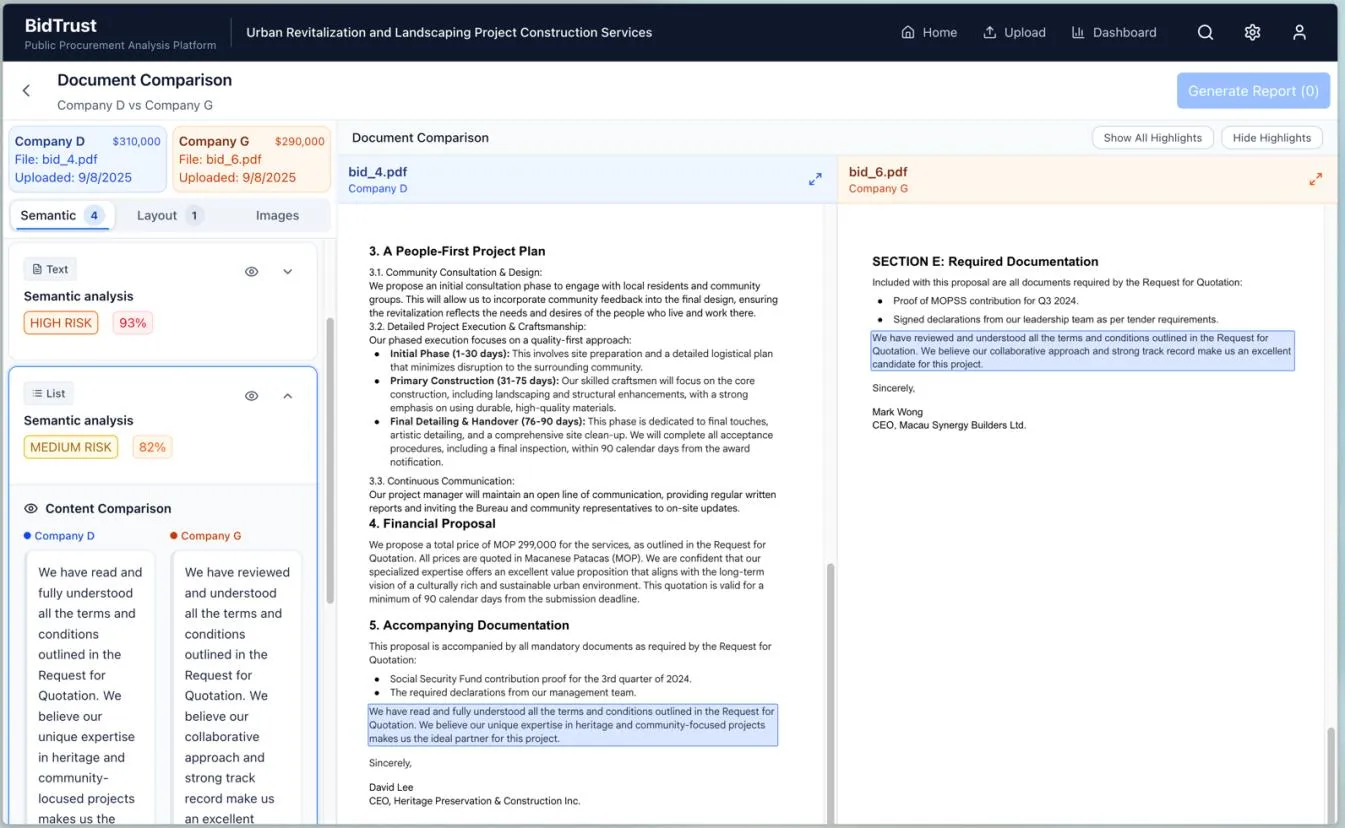
Using advanced embedding models, it understands the real meaning of text, not just the literal words. Even if a bidder deliberately swaps vocabulary or restructures sentences, identical substance is still detected — the key to catching 'same wine, new bottle' plagiarism.
2. Structural analysis
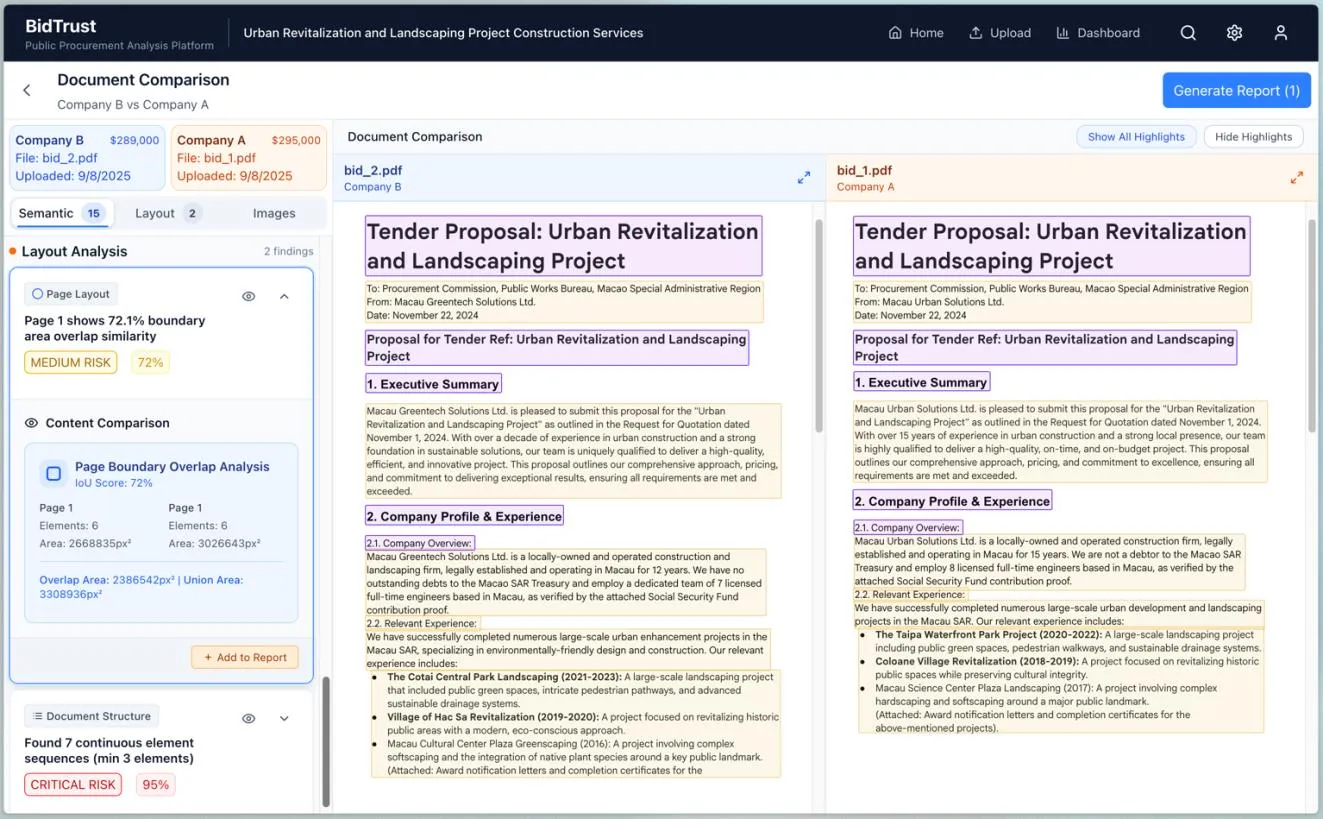
Using computer vision and layout analysis, it compares each document's structural blueprint and element arrangement. If two 'independent' companies use the same master template, the geometric features of their layouts overlap heavily — strong evidence of structural copying.
3. Image analysis
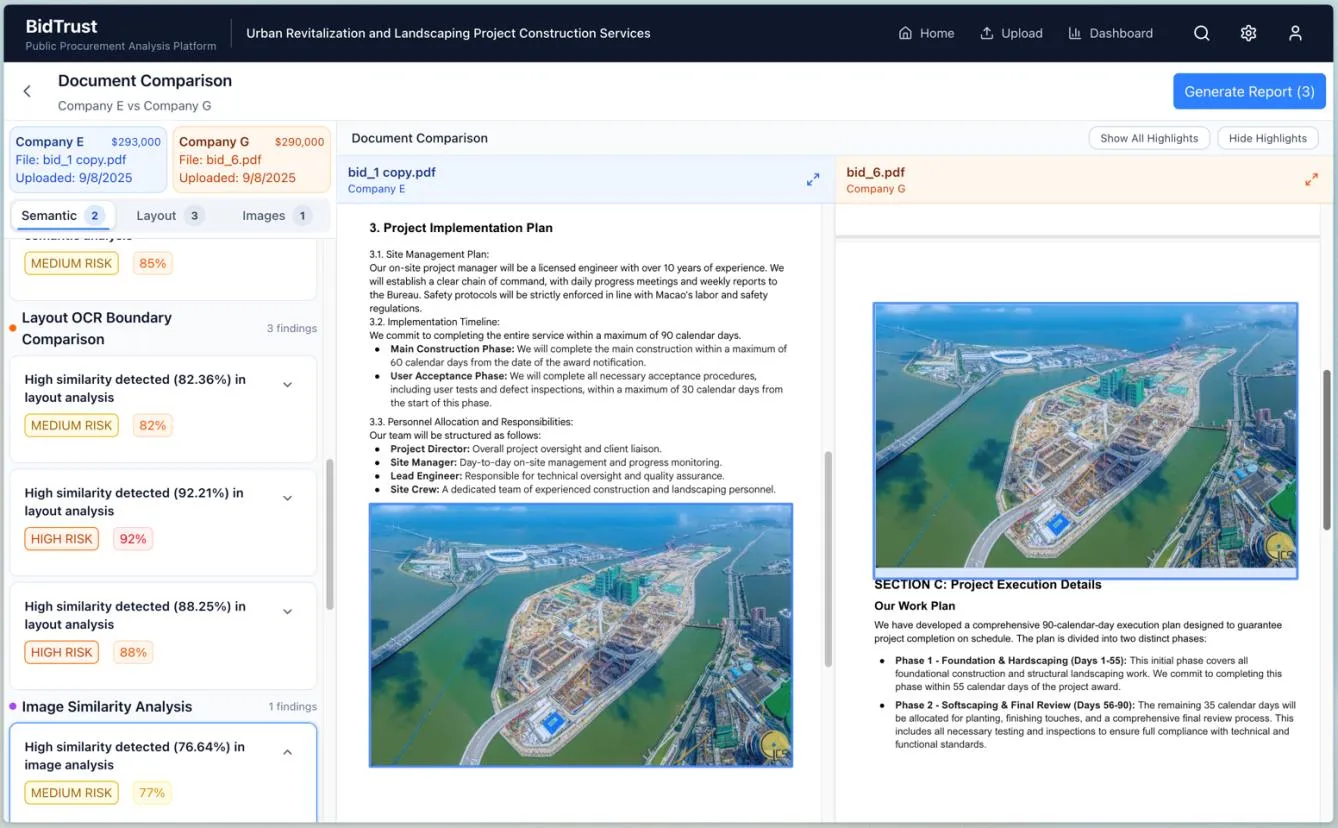
Using perceptual hashing, it compares charts, engineering drawings and site photos inside the bids. When two bids from different companies contain the exact same project photo or drawing, it is often a clear signal of collusion.
The full workflow: from upload to report
- Bulk upload tender PDFs — import every document at once.
- The system automatically runs OCR and three-dimensional similarity analysis.
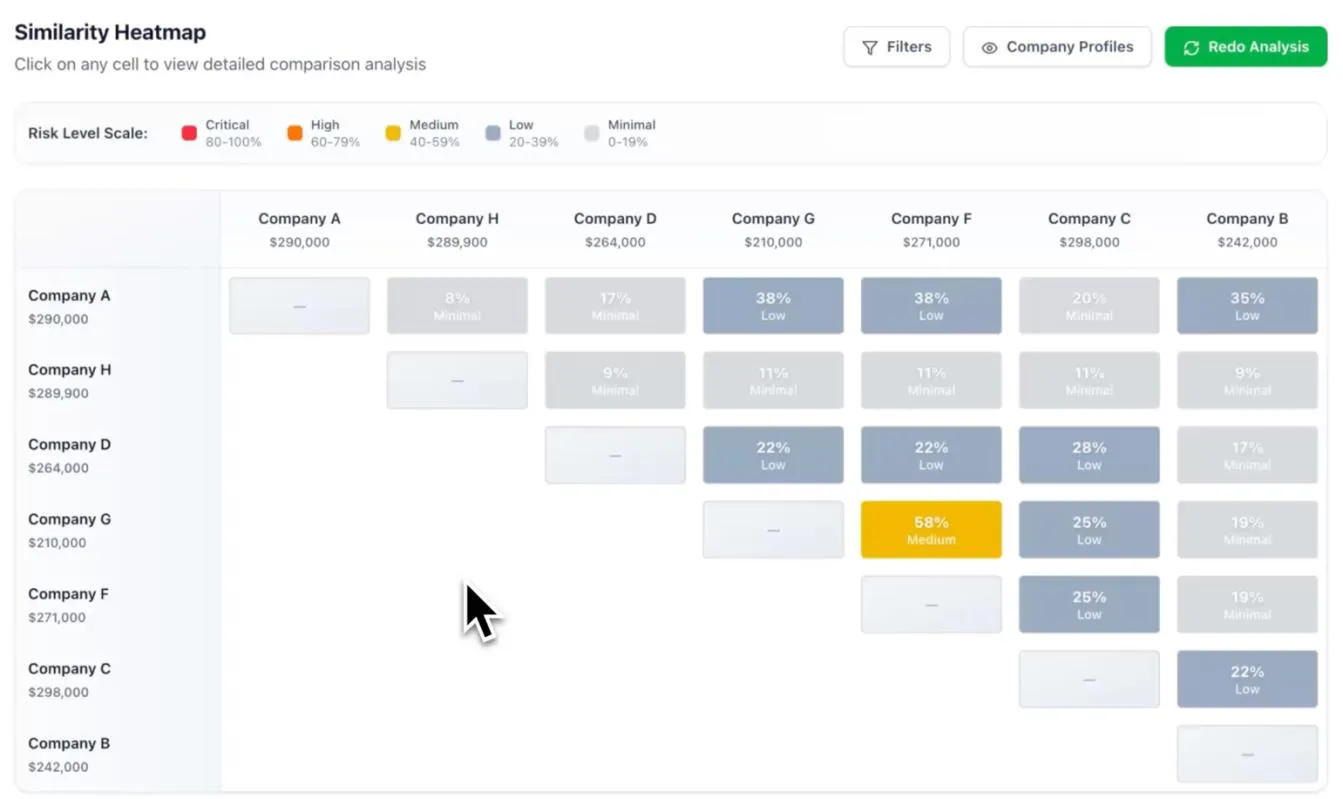
- View the similarity heatmap on the dashboard; red cells are high-risk pairs.
- Click any suspicious pair to open the side-by-side comparison and review semantic, structural and image evidence item by item.
- Flag key findings and generate an audit-report draft with one click.
- Edit, annotate and export the final version.
A real scenario: a large infrastructure project with 50 bidders would once have taken weeks of manual screening. BidTrust completed every cross-comparison in hours and precisely flagged 93.8% overall similarity between Company E and Company G — with image similarity reaching 100% (the same site photo reused).
Smart report generation
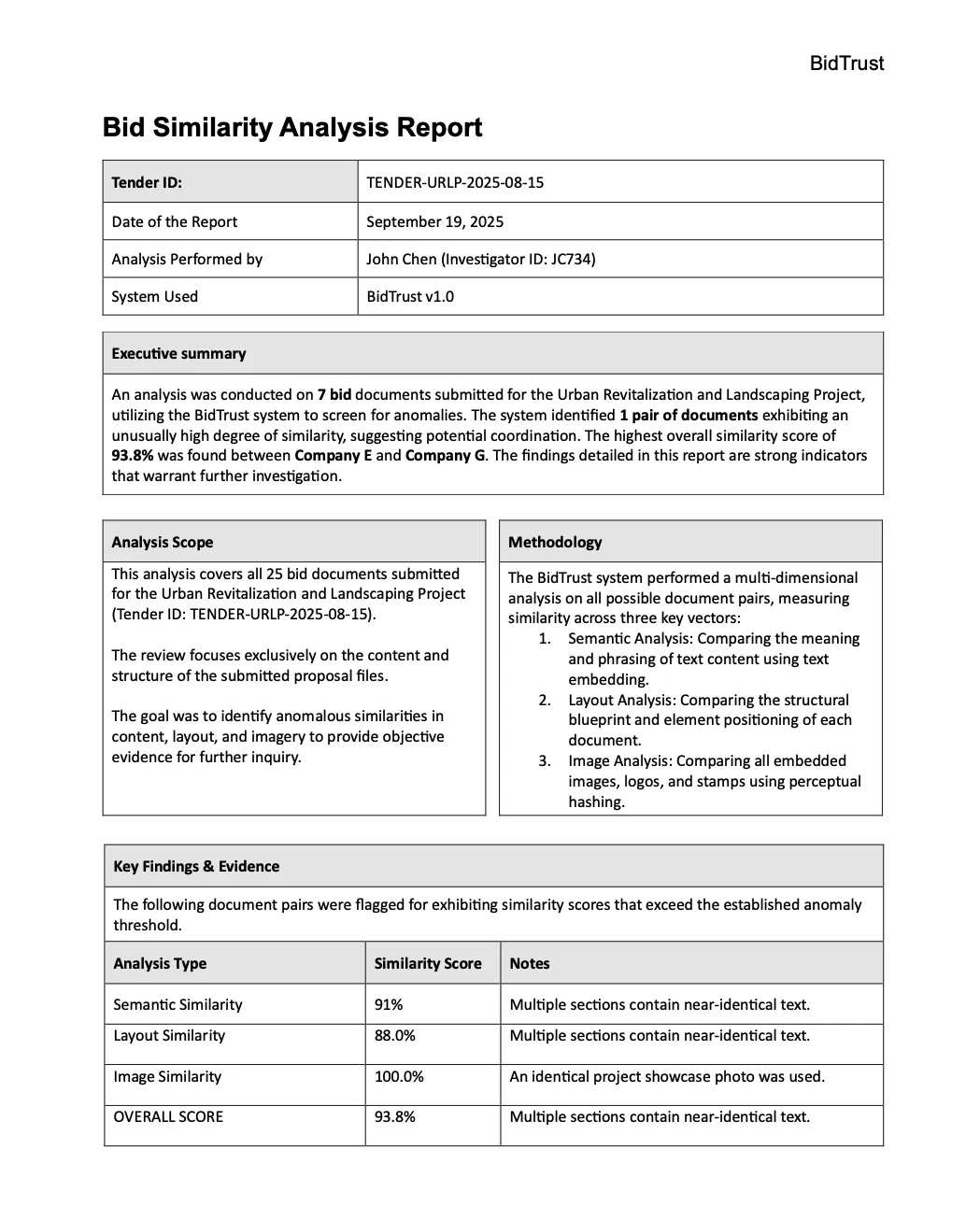
Once analysis finishes, BidTrust auto-drafts a structured report from the results, combining similarity scores, evidence screenshots and risk assessment, formatted to government reporting requirements. It exports to PDF, Word and HTML — almost no gap between "finding the problem" and "producing submission-ready evidence".
On-premise: data never leaves the network
For governments and audit bodies, tender data is highly sensitive. BidTrust runs fully on-premise:
- All AI inference runs locally, with zero external API calls.
- Documents are processed inside the institution’s own infrastructure; data is never sent to any external service.
- Embedding models are cached and run locally; analysis results are stored in a local database.
This design satisfies the highest confidentiality requirements of government departments from the ground up.
Technical architecture
BidTrust is built on mature open-source technology, balancing performance, maintainability and deployment flexibility:
- Core architecture: a Python backend and a TypeScript frontend, cleanly separated
- Data layer: a relational database with built-in vector retrieval
- AI models: a multi-model OCR pipeline (layout detection, table-structure recognition, text recognition) plus semantic embedding models, all open-source and on-premise-capable
- Design principles: modular architecture, API-first, bilingual (Chinese/English) UI switching
Forged on the international stage
BidTrust is not theory. It originated at Coding4Integrity 2025, the Asian youth anti-corruption hackathon co-hosted by the UN Office on Drugs and Crime (UNODC) and Hong Kong’s ICAC:
- Champion of the Asia regional (Hong Kong) selection
- Super Team at the global final in Doha, Qatar
- Best Team Player — voted by the competing teams from all countries
That international recognition was the starting point for BidTrust’s journey from competition prototype to a real procurement-oversight application.
In closing
BidTrust is an intelligent analysis tool built for procurement oversight. Through advanced AI, it helps auditors:
- Quickly identify abnormal similarity across bids
- Provide complete evidentiary support through multi-dimensional analysis
- Lower the expertise bar with an intuitive interface
- Keep data secure through on-premise deployment
- Dramatically shorten review time
It is not here to replace professional judgement, but to make procurement oversight faster and sharper — a genuinely usable tool for building clean, transparent public procurement.
Have something you want built?
Email or use the form. For websites we'll build a free demo; for bigger builds we'll scope it with you.